

I’ve long been a small business junkie. I spent much of my journalism career writing about innovative small businesses that grow quickly by building important products, often in technology. I especially love to see brilliant entrepreneurs guide small quirky companies like Amazon, Netflix, and Priceline into public companies that explode in price and make huge amounts of money for shareholders.
Last week, one of these quirky companies that went public was something called Beyond Meat, a plant-based meat substitute with the symbol BYND. It was supposed to open on Thursday at $25 a share. Before the day was over, it had soared 163%, to $65.75, to become the biggest one-day IPO gainer of the year. (By the end of Friday, it was up further, to over $66 a share.)
Beyond Meat is intentionally targeting big producers like Tyson Foods with its new offering, rather than positioning its product as a vegan offering, according to Forbes: “BYND has made a point to market its products as meat rather than as a vegetarian alternative. Its products are sold in the meat section of grocery stores, and it has long resisted the labelling of its products as ‘veggie burgers’.
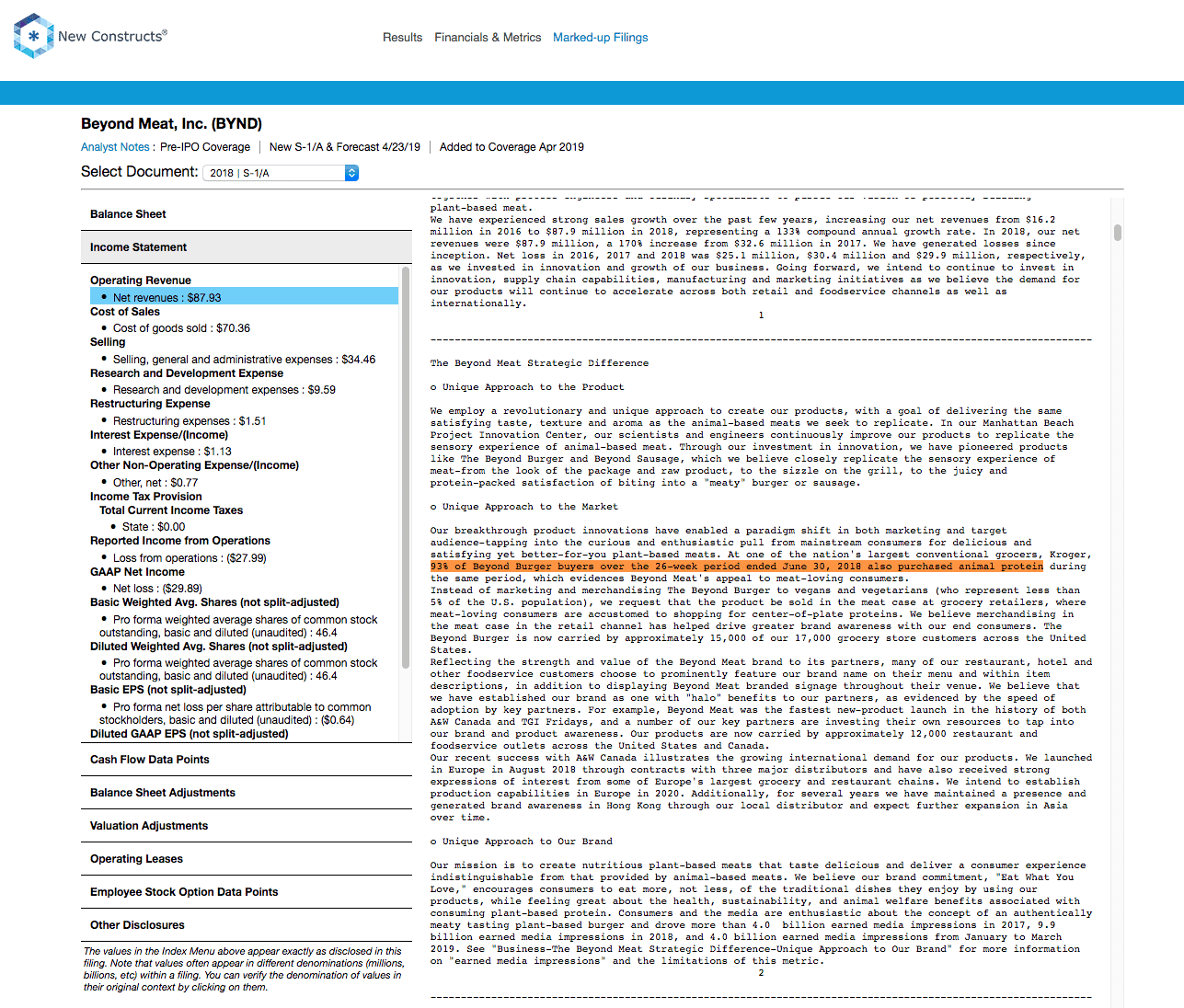
“This strategy of marketing their products towards meat eaters appears to be working so far. The company claims in its S-1 that 93% of customers that bought a Beyond Burger at Kroger in the first half of 2018 also purchased animal meat products during that timeframe.”
I know many people here hate the idea of artificial-any-food, but I take a different view. So long as it’s made from healthy and natural products—in this case, a variety of plant items—I say go for it, if there’s a market for it. From all I can tell, Beyond Meat is much healthier than any of the meats put out by the Big Ag companies with their antibiotic-laden products from their polluting CAFOs.
I also love to see these young exploding companies eat the lunches, as it were, of the big corporations. The Forbes article said that Tyson Foods is planning to eventually sell some kind of meat substitute to compete with Beyond Meat. How much do you want to bet Beyond Meat makes mince meat out of Tyson? It’s a situation not unlike what’s happened in the dairy marketplace as plant-based “milks” (soy, almond, coconut) have taken huge marketshare from big boys like Dean Foods, whose stock is way down.
In any event, it’s possible for any of us to make out in this marketplace. Lots of money has been made from the most successful IPOs of the last decade, like Facebook, Netflix, and Google, and it’s made in significant measure by individual investors who make smart choices about which of the IPOs to bet on.
In the food arena, there’s another one of these companies on the IPO horizon—Impossible Foods, which will be supplying Burger King with plant-based burgers later this year. That will allow this junk-food franchise to offers a burger that is actually kind of healthy.
As for BYND, which is actually out there, I’d be hesitant about throwing money at it right away. One of the crazy things about IPOs is that they can start out strong, and then crash and burn in the intervening weeks and months and years. Remember Fitbit, the digital watch maker? Started out over $45 a share in 2016 and is now around $6 a share. Same with GoPro, a maker of video cameras for swimmers, which made it up over $80 a share back in 2015, and is now around $6 a share. If you look at the analysis in the Forbes article I linked to, the valuation associated with BYND may be a little rich, given the underlying company and market realities.
These IPOs are part of capitalism’s way of dealing with problems like small conventional dairies that are being decimated by low prices and Big Ag monopolies that bribe politicians and continue turning out poison substituting for food. It’s not pretty, even cruel in certain respects, but it’s how a free market deals with products that have outlived their usefulness, and ushers in improvements.
Investing in IPOs not for the faint of heart. But it’s neat if you can make out financially, and be involved in a company that’s actually doing some good for society.
Fully agree with you about artificial-any-food.
The fact that such food can be harmful is a myth?
Before embracing this kind of food, I’d like to see it tested because if it’s made from any GMO ingredients, chances are it is laden with glyphosate. If the plants used are organic or biodynamically grown it could be good for the planet as well as possibly tasty.
BYND claims that their artificial meat products are GMO free. That said
Glyphosate use is not limited to GMO crops; it is used on all land where all crops will eventually be grown. Glyphosate is also extensively used as a pre-harvest desiccant on most grain oilseed and bean crops…
This much I do know, if the Bill Gates Foundation Tyson’s and the fast food industry are taking an active role in this fake food/meat process by investing for example in the “Impossible Burger”, which is made from genetically engineered yeast, then that should raise our level of skepticism since they both organization lobbied in favor of the Dark Act and the non labeling of foods that contain GMO ingredients…
Although fake meat may appeal to vegetarians, animal rights groups and anthropogenic global warming proponents; the process is no substitute for diverse and sustainable farming practices…
Agree. But glyphosate not allowed in organic farming so best bet for vegetarians and vegans is to stay within that if they are looking for meat alternatives. Small farmers – not groups like Horizon etc. – honor a true organic method so that, so far, is the only way to get minimal exposure from glyphosate. Even though it is such hard work, small organic farms are growing in number. People – albeit slowly – are waking up to the evils of “big food” in all forms.
Just remember that many smaller farms are organic, but avoid the certification because of the substantial costs involved with getting the USDA certification, and keeping it. I suspect that’s what’s involved here.
You are very correct in that David, we are one of those farms, been organic for over 35 years, but not willing to go through the certification process, for several reasons, and we know quite a few farmers that feel the same as us.
Good question. The company says on its web site that “All of our US-based products are currently Non-GMO Project Verified, including The Beyond Burger®, Beyond Sausage®, and Beyond Beef® Crumbles.” Also says that while it isn’t using certified organic ingredients, it has a goal of being certified organic.
https://www.beyondmeat.com/faqs/
Law of unintended consequences.
Change one thing and other things change that you did not expect.
I have read that Burger King is already selling Impossible Burgers in some markets.
Hi Steve! Hope all is well! Lots of time has passed. Hard to believe my Chris is 20.5 years old and the same old comments on this blog. LOL
I’ll take real ground beef, even CAFO beef, over this:
The Beyond Burger: pea protein isolate, expeller-pressed canola oil, refined coconut oil, water, yeast extract, maltodextrin, natural flavors, gum arabic, sunflower oil, salt, succinic acid, acetic acid, non-GMO modified food starch, cellulose from bamboo, methylcellulose, potato starch, beet juice extract (for color), ascorbic acid (to maintain color), annatto extract (for color), citrus fruit extract (to maintain quality), vegetable glycerin.
I don’t see product claims for no MSG, which can be found in “natural flavors”.
Funny, you’ll take CAFO beef, which openly uses GMO feed, and often contains antibiotics, over a certified non-GMO product. Your choice.
Personally I’ll pass on both,CAFO beef or fake meat.LOL!!
Interesting article on this topic in today’s Mercola newsletter:
https://articles.mercola.com/sites/articles/archive/2019/05/06/grass-fed-or-lab-bred-meats.aspx
Yes, it is an interesting article. I agree with him that the optimum goal is more grassfed meat. What he doesn’t say is that producing that on a large scale, at affordable prices, is a very long-term prospect, longer than many people are willing to wait. In typical Mercola style, he plays loose with the facts, grasps at straws, and does a lot of fear mongering. He never mentions Beyond Meat, the largest of the emerging companies in this arena, which uses certified non-GMO ingredients. Instead, he cherry picks speculative articles aboutt lab-grown meat where artificial chicken nuggets cost $50 apiece. Not real helpful.
Remember when margarine was promoted as a better than real butter? After that health disaster, butter is making a comeback.
Exactly!!!
You are absolutely right.
Agree with all your points David. As Peter Diamandis says, “Fear sells because the amygdala is always looking for a threat,” and no one I know of (with the obvious exception of our current president) has better mastered that reality.
I recently watched a video tour of the Beyond Meat R & D lab with founder Seth Goldman (who founded Honest Tea then sold it to Coca Cola). Beyond Meat has dozens of PhD scientists working to turn their principle raw material, pea protein, into faux foods that resemble meat in every conceivable way. In this age of uber-transparency and heightened focus on health and sustainability their success depends on how well they’re able to addresses all the objections, valid and perceived, already arising from the myriad competing vested interests.
Jeez, BYND up another 10%+ today, over $71 a share…..in a down market day.
The junk/fake food industry, BYND meat products included, is all about manipulating and controlling consumer perception in order to gain the upper hand in sales. To this end, manipulation and adulteration of food coupled with government mandates that restrict the availability of natural whole living foods has no limit. There is no sustainable artificial substitute for organically raised beef, lamb, pork, chicken or real raw milk and butter.
I personally agree.
Perhaps it is worth saying that in the near future such a substitute will be created?
no-one ever went broke UNDERestimating the taste of Americans. this ‘faux-food’ will do very well … as BeyonCe~Meat rides the latest religious fad, vegetarian-ism … one more tragic example of consumers entranced by The Image, versus the real thing. Know ye not that vegetarian-ism is a doctrine of devils?
does not matter to us in the Campaign for REAL MILK, though. We survive and thrive with actual nutrients in raw milk, and the red meat from our herds. Those fooled by commercial non-sense, come calling on us, when their health gets bad enough
Every now and then I have to agree with you Watson,LOL!!
Hey Gordon and Ken, are you aware of a new market for older milk producing cows? I thought this to be a promising development for farmers: to go from the head-to-toe concept, to a baby-to-senior marketing enterprise.
https://modernfarmer.com/2019/04/new-country-for-old-cows/
thank you OraMouse, for this URL lead. In the advertising biz, they say “the more you tell, the more you sell”. The people who are creating the specialty market for matured red meat are doing something along the line of what Mark McAffee has done with REAL MILK = educated consumers with more and better information.
Wrapping great amounts of accurate information around their product, they created value, which translates into huge percentage increase on the ‘bottom line’.
Bucky Fuller was always talking about the factor of weight in technological improvment. He taught us : “information is the most valuable commodity of all, because it weighs nothing”. Such a specialty /boutique niche market is where small-holders can outflank the giant CAFOs.
it is amusing to watch this demonstrated at retail supermarkets in British Columbia. A decade ago, when our raw milk cowshares were just getting noticed, the dairy quota holders were paying close attention to us. We boasted about how ‘grass-fed is best’. that theme is now a major sales pitch of the retailers… nice big posters of a farm family with scene of their pasture in the background. And no small co-inky~dink these show smiling faces of white folks, in a traditional nuclear family. People concerned about clean food, do not buy into the homosexual / trans-bender LGBTQ2??? weirdness
KEEP SMALL FARMERS
https://www.thelunaticfarmer.com/blog/
“This is unheard of in the U.S. Being free to develop and operate his own micro-processing facility, which cost less than $10,000 to set up, is a freedom Americans (and Canadians) lost decades ago.” Emphasis in brackets is mine.
…“The only reason factory farming is still on the ascendancy in the U.S. is because competitive innovation is held in check by draconian and tyrannical government food regulations that make market entry exorbitantly difficult. What a difference it would make if the U.S. had a small-farmer mystique, permeating through its bureaucracy, that would offer breaks to on-farm micro-processing. Innovative entrepreneurs would sprout like flowers in a sidewalk, offering alternatives to factory fare competitively priced and accessible. It would be a game changer.”
Observations of a Retired Dairy Farmer
https://www.lancasterfarming.com/news/editorials/observations-of-a-retired-dairy-farmer/article_cecf8809-248c-53e2-b63b-2cf3a35cc0da.html
Long-term benefit of Microbiota Transfer Therapy on autism symptoms and gut microbiota
https://www.nature.com/articles/s41598-019-42183-0?fbclid=IwAR2FEqPpnOOY3vGFGFdAHqkWeEeu3fQgL-a2r9LtgJAmAAOgiPPwycCUTos
Longitudinal Study of Shiga Toxin-Producing Escherichia coli and Campylobacter jejuni on Finnish Dairy Farms and in Raw Milk
https://aem.asm.org/content/aem/85/7/e02910-18.full.pdf
Explains why Mark keeps having outbreaks despite RAWMI standards.
Mary,
125 million servings and growing strong. Test and Hold is working great. Most importantly, lives are being saved and health is being improved. Asthma, Crohns, inflammation decreased, colds reduced, immune systems strengthened. Products in 1100 stores in North America!
That’s not any sort of unsafe trend. Have you lost it??
Stay current, stay accurate.
I know you like rewriting history.
May I add that the Finnish raw milk pathogen study did not research or study any RAWMI listed dairies. The Finnish researchers considered hygienic high quality raw milk to be less than 50,000 SPC.
In the RAWMI RAMP book, that’s grossly filthy. In CA that barely qualifies for pasteurization. The upper limit in CA is 50,000 SPC to send milk for pasteurization.
At RAWMi our routine samples for SPC run in the less than 500 range per ML. OPDC routinely gets less than 200 SPC and less than 1 coliforms. The Finnish never mention coliform levels?? Thats a dead give away. They are measuring really dirty milk!
The Finnish researchers missed the boat entirely. Their definition of clean or sanitary applies to pre pasteurized raw milk. Not RAWMI raw milk that is intended for consumption by people. This is another attempt to bash clean raw milk. It also does a very poor job of covering up this attempt. 50,000 SPC is the upper limit for pre pasteurized raw milk that is being sent to the pasteurizer.
That’s really over grown milk that is heavily burdened with bacteria. Defining these samples as sanitary is a misstatement of standards and portrays ignorance. The Finnish researchers don’t know much about raw milk for human standards.
It is classic that Food Safety News would carry this article. Anything to hurt raw milk. What a scam. Really stretching standards and playing on the ignorance of the readers.
Mark, you missed the entire point of this 11 page study. Instead you focused on a sentence on page 10 that really didn’t have anything to do with what was discovered. This study gave great information on how long pathogenic E.coli and Campy can live on a farm, as well as the different ways these pathogens behave. Testing the milk filters is a more accurate sample for pathogen contamination versus the bulk milk sample.
I’m glad you did bring up the Standard Plate Count numbers. I’ve always wondered what happens once you milk leaves the farm and is in the store. Please scroll down to the end of this report. Can you explain these high numbers for your OPDC products? I know this was pre RAWMI days, but it still seems extraordinarily high. It definitely shows that bacteria grows in milk.
https://www.cdc.gov/mmwr/preview/mmwrhtml/mm5723a2.htm
what those figures show, is : you’re living in the past. … Still floggin’-away on that tired old One-Trick Pony of yours. Meanwhile, we have 160 test results over 2 years, from a completely -independent world-class commercial laboratory, proving that the RAWMI-certified farms in B. C. deliver REAL MILK with lower bacteria counts than the pasteurized stuff on the shelves of retail stores. The nature of evidence is that it can be tested … and we have the evidence.
in Canada, the package of “homo milk” has a 30-day expiration date. Go get a quart of the cooked, commercial stuff available there in California … take it to a lab to be tested for plate count et cetera. and post the result on this forum? But you wouldn’t dare … because – even as despicabilly unfair as you are Mary M McGillicuddy – you’re smart-enough to know that that ( so-called ) “milk” in commerce is not as clean as Organic Pastures’
Good Grief, I agree with you twice in one article, What is going on??? LOL!!
Mary M. PLEASE STOP!!
Glyphosate and Glyphosate‐based herbicide exposure during the peripartum period affects maternal brain plasticity, maternal behavior and microbiome
https://onlinelibrary.wiley.com/doi/pdf/10.1111/jne.12731
I still have vivid memories of when the “experts” or scientists and Ag. Reps. if you will were telling us that glyphosate was biodegradable and not harmful… My response to them, “anything that has such a wide spectrum of toxicity cannot but be harmful”.
Yep, remember them saying it will bind with clay particles and become inert.
California jury hits Bayer with $2 billion award in Roundup cancer trial
https://www.reuters.com/article/us-bayer-glyphosate-lawsuit/california-jury-says-bayer-must-pay-2-billion-to-couple-in-roundup-cancer-trial-idUSKCN1SJ29F
Next step to watch. Roundup is going to go missing in American stores. It is done. The jury sent a message. Monsanto lied and now it is going to pay. Bayer is now paying for its miss deeds in WW2. Its payback time!! Sorry that consumers must pay with their lives in order to get the attention of the bad science.
Yea! Payback time now.The lives of people are not worth bad science.
If one considers the systemic nature and ubiquitous presence of glyphosate in the environment, coupled with the way in which vaccines are manufactured, then this should be of no surprise…
“Earlier this year, Moms Across America sent 5 childhood vaccines to an independent lab to be screened for glyphosate. All 5 tested positive for glyphosate, with the MMR vaccine showing levels 25X higher than the other vaccines.”
https://www.momsacrossamerica.com/glyphosate_in_vaccines_letter_to_fda_cdc_nih
On a more positive note, consider this very recent statement from Robert F Kennedy Jr.,
“What a Day! In addition to our miraculous triumph against Monsanto, we just killed mandates in Portland. Yes People! Oregons vaccine bill is DEAD!
‘The reason the bill died is because Republicans stood up for our most fundamental civil rights. Plus, our community mounted the most intensive and well organized grassroots campaign in Oregon history. Special thanks to my heroes Sarah Bacon and JB Handley and all the noble warriors at Oregonians for Medical Freedom who won this hard earned victory for our children.
‘We faced down the largest media firestorm on measles in history, meticulously orchestrated by Pharma, it’s captive regulators, and media dependents. They had the gift of an outbreak 10 miles from the Oregon Border A majority of Dems still couldn’t pass the law. Thank God that Oregon legislators still listened to facts.
I’m ashamed of my party and grateful for the GOP’S courage in standing up to Pharma.”
It’s in the Weeds: Herbicide Linked to Human Liver Disease
Exposure to glyphosate, the primary ingredient in the popular weed killer Roundup, correlates to more severe cases of nonalcoholic fatty liver disease
https://health.ucsd.edu/news/releases/Pages/2019-05-14-herbicide-linked-to-human-liver-disease.aspx
eater:
https://www.eater.com/2019/5/14/18623258/impossible-foods-synthetic-lab-grown-meat-science?fbclid=IwAR1L0O7tr0DoKNZQkKydoq5DI1c0l5Hj5CyHJK0Yj9OmNkERNl7A8zrH5ng
Mary,
To be clear. I did not miss the high bacteria count message at all.
All raw milk grows until it reaches a critical limit of its own capacity to grow bacteria given the food it can eat and conditions of ph etc. its called lactofermentation. It is relative to time, temperature, initial bacteria count and amount of prebiotic available. It is one of the qualities in raw milk which assures its own safety. As bacteria grow, lactic acids are created and the ph drops. Low ph then inhibites the growth of pathogenic bacteria. Its a brilliant natural process.
But….initial Bacteria counts should not be high. The starting bacteria count of clean chilled fresh raw milk should be extremely low.
The Finnish study defined this fresh chilled clean raw milk as being 50,000 SPC. That is not clean and is certainly not fresh. That milk had been temperature abused and or aged and had plenty of dirt to begin with. Who knows what the cont was at the time of milking? Who knows the conditions of the health of the cows or the biofilm status of the milking systems.
In CA this milk would be degraded and could not have been sent to be Grade A pasteurized if it tested at 51,000 SPC. That’s how bad it was.
I expect my milk to be very low for SPC during the first days in the market place, but as days and two weeks pass I expect those low numbers to become very high to the point of eventually being sour.
That is the expectation of raw milk. High bacteria counts do not mean pathogenic bacteria are present ! When aged over time.
We test for pathogenic bacteria at the start. If they are not present they don’t magically appear later. In fact in raw milk the odds become lower and lower that a pathogen will survive.
In fact our raw kefir is an excellent example of extremely high bacteria count yet clean raw milk with zero pathogens present. Bacteria double their count every 22 minutes at body temp!
The Finnish study simply does not reflect good science in their approach when asking the right questions in pursuit of identifying methods to produce safe clean raw milk.
Look at the RAWMI Common Standards and RAMP programs to find that pathway.
Filters are “super concentrators”of bacteria and everything found on a farm. They do not reflect what is found in raw milk. If filters where such a good thing to measure raw milk safety, they would be utilized under the FDA BAM manual. Instead they are forbidden. How do I know ? Moore SWAB testing is a form of filter test and it is forbidden to test for pathogens in fluid milk under the AOAC BAM FDA lab standards.
You don’t drink milk filters, you drink raw milk. There is a huge amount of science and along history behind all of this. It is not as simple as you think.
Quebec cattle producers take issue with advertising of Beyond Meat burger
https://www.cbc.ca/news/canada/montreal/quebec-cattle-beyond-meat-1.5134951
Herbivores such as cattle are indeed the original true source, if raised organically, of unadulterated “plant based meat”…
Very shortly, you watch. It will be a GMO fight. All that plant based ingredient will contain plenty of Roundup.
A FOOD CHAIN RADIO RELEASE FROM MICHAEL OLSON
In 1990, “organic” meant anything made of carbon and was therefore not worth much as a word. Today organic means “foods grown with integrity” and the word is worth over $50 billion dollars! Leads us to ask:
Will it be possible to keep organic organic?
Michael Olson’s Food Chain Radio show/podcast hosts Dave Chapman from the Real Organic Project for a conversation about keeping soil in organic agriculture.
Topics include how the official definition of “organic farming” was built upong biological soils; how that definition was changed to include no soil; and what no soil means to those who buy organic food.
Listen anytime here: Food Chain #1186
The link for Food Chain #1186 is https://metrofarm.com/mf_Food_Chain_Radio.php/
GMO Impossible Burger Tests 11X Higher for
Glyphosate Weed Killer Residue than
Beyond Meat Burger
https://www.momsacrossamerica.com/gmo_impossible_burger_positive_for_carcinogenic_glyphosate
It appears that Canadians may need raw milk even more than Americans.
There is a gene mutation that effects the ability for Alkaline Phosphatase enzymes to function properly. The HPP mutation is expressed at relatively high levels in parts of Canada. It just so happens that raw milk is an excellent source of the fully active Alkaline Phosphatase enzyme. The results are pretty horrible. Loss of teeth, bone loss and other severe health issues. It is thought that vitamin D plays a part in this dysfunction. Vitamin D deficiency is rampant in the north latitudes. Raw milk is also deficient by decree of the Canadian government.
https://www.ncbi.nlm.nih.gov/pmc/articles/PMC4824800/.
glad to see you’re paying attention to what hard science is finding out, about genetics, Mr McAffee … after you disparaging me so badly because I say that God has given the white race a special advantage in the trait that we – white people – to continue making Alkaline Phosphatase during our whole lifetime, versus production of that enzyme dwindling after weaning, in individuals in other races.
the maxim that “people can learn at any age” includes you
about 20 years ago, I gave up my effort on the anti-abortion front, because I thought the cause was lost. It was not : God Bless the people who just kept on going out on the public sidewalk, presenting FACTS to prick the conscience of the nation
It’s not that Americans won’t come around ; it’s that they’re slow to come ’round. Today, the Great State of Alabama enshrined common sense in to the law of the land = making it a crime to kill a human being in the womb. They did that on the basis of hard science … the genetic proof is un-arguable. So the Pendulum of received wisdom is swinging ALL THE WAY back to what a wise Judge said from the Bench in one of our trials = “everyone knows it’s a baby”
The Impossible Burger is made of Soy!
So now we have Roundup to bring on cancer and soy to grow Manboobs , elevate estrogen levels and kill off sperm count. Isn’t that a wonderful combination. Yum
you got it. God Almighty said : “Go forth and multiply”. His enemies attack that dictate every possible way. By making artificial birth control freely available. So that artificial abortion would then plague the nation. Lately, it’s the INSanity of “transitioning from one gender to the opposite”. Jesus Christ said – sarcastically – “who, by taking thought can add a cubit to his stature?” Yet we now see over-educated idiots in the Cult of the White robe ( who call demselves “physicians” ) co-operating in the mental illness of pathetic souls deranged with A-pot-em-no-philia ….cutting off perfectly healthy body parts / injecting poisonous substances / hormones
I recommend that people who actually produce REAL MILK, seriously re-consider the practice of taking milk from a cow which is pregnant. The science has been done to prove that such milk has 30, 000 times [ thirty thousand times ] the estrogen as milk from a cow which is NOT pregnant. That factor has huge implication for the development of boys to men. Combine that with the FACT that fluoride disturbs thyroid function, and we start to see why the health of Americans – since WW 2, when fluoride from atomic energy production had to be dumped somewhere ( the water supply of cities! ) has degenerated so drastically. No mere co-incidence that the men who wrote the US Constitution mentioned “enemies domestic and foreign” The enemies of our God managed to poison our water supply / poison our foodstuffs – according to their character – as they have, for the past 3700 years.